
Computer vision · Industry
Visual quality inspection
Detect defects, measure parts, and monitor processes with cameras your line can trust.
First working version in 6–10 weeks
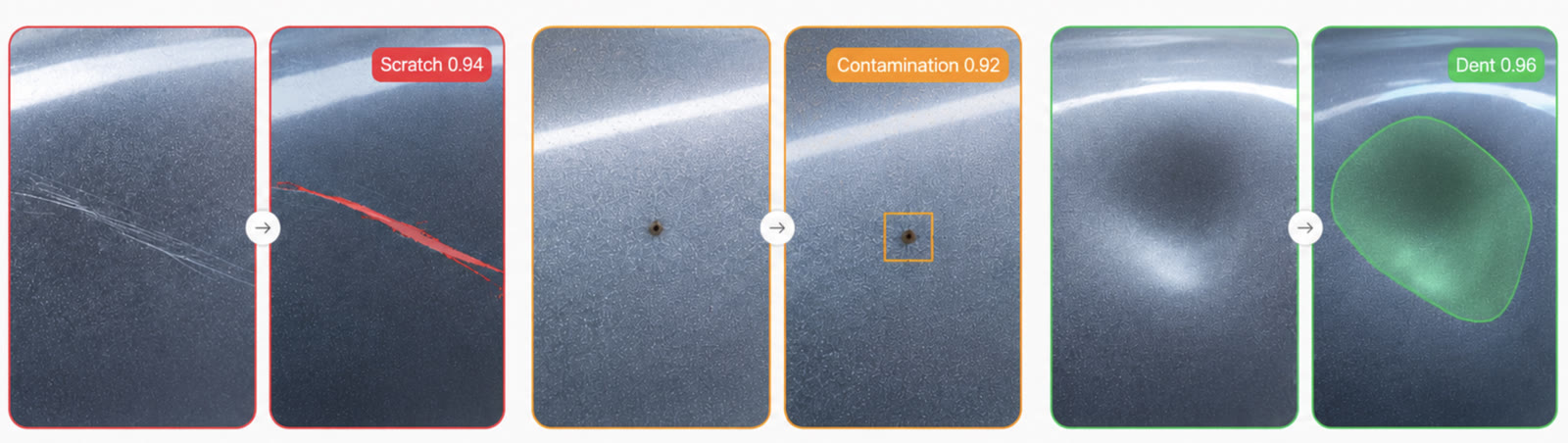
The problem
Manual inspection is slow, inconsistent, and hard to staff. Camera vendors sell hardware, but the intelligence — models tuned to your defects, integration with your PLCs, interfaces your operators accept — is the part that decides whether the system gets used.
The hard problems are rarely the model alone: variable lighting, line speed, small or rare defects, calibration drift, and the gap between a demo and a station that runs every shift.
Our approach
Feasibility on your images
We test detection approaches on your real samples before anything is built, and tell you honestly what accuracy is achievable.
Data and annotation strategy
A pragmatic plan for collecting and labeling images, including rare-defect handling and synthetic augmentation where it genuinely helps.
Model development with agreed metrics
Detection, segmentation, or measurement models evaluated against acceptance criteria you sign off — not demo-day accuracy.
Deployment and integration
Edge GPU inference on the line, calibration tooling, and communication with PLCs and existing automation.
Operator tooling and monitoring
Review interfaces, logging, alerts, and reports, so the system earns trust instead of demanding it.
Reference architecture
- Industrial or high-speed camera with controlled optics and lighting
- Edge GPU inference (real-time detection, segmentation, measurement)
- Calibration and pixel-to-unit measurement tooling
- Operator interface with review, override, and statistics
- PLC / SCADA communication (Modbus TCP/IP and industrial protocols)
- Database logging, traceability, and automated reporting
What you get
- A working inspection station on your line, not a slide deck
- An accuracy report against acceptance criteria agreed up front
- Operator training and full documentation
- A roadmap for scaling to more lines, products, or defect types
Proof. Our industrial vision systems run in real production environments — from water-treatment infrastructure to the NASA-award-winning bioprocess technology of Eternal's space division.
See what your line's cameras can really do.
A 30-minute call is enough to tell you whether this is feasible on your data.